
ChatGPT vs Claude 2026 platform evaluations show that large language models have shifted from general intelligence races to a battle of specialized operational strengths. Recent architectural upgrades and refined algorithmic logic have caused many copywriters, developers, and digital marketers to question their original subscription loyalty. Evaluating these feature shifts on specialized portals like Best AI Tools will help you match your workplace needs with the platform that handles your daily projects with the least amount of technical friction.
Evaluate 4 Practical Performance-Driven Reasons to Execute a Strategic System Migration

Analyzing modern automated engines requires looking closely at how they handle deep, multi-layered text generation tasks under tight commercial deadlines. Industry-wide ChatGPT vs Claude 2026 comparison logs point to four clear operational areas where switching your primary platform completely redefines your professional daily output:
CURRENT: ChatGPT vs Claude 2026: 4 Concrete Reasons to Switch Your AI Assistant
- Humanlike Prose Synthesis: One framework generates text that reads naturally with subtle emotional calibration, avoiding the stiff, highly predictable paragraph patterns commonly produced by older algorithmic layouts.
- Massive Technical Memory Pools: Moving to a system that accommodates massive raw text files inside a standard paid conversational window prevents the platform from forgetting initial parameters during long projects.
- Deep Multi-File Code Refactoring: Working with an environment that actively traces variable dependencies across multiple uploaded script sheets guarantees cleaner, more compilable software debugging.
- Persistent Variable Project Sandbox Containment: Organizing distinct operational workspaces with unique uploaded reference logs ensures your assistant maintains context without manual prompt copying.
Highly Detailed, Realistic Performance Realities in the ChatGPT vs Claude 2026 Competitive Landscape
Moving beyond initial software marketing promises reveals that the two leading consumer platforms have developed completely contrasting processing personalities. These behavioral differences become highly apparent when teams demand high-volume production without constant human editing.
The Contrast in Default Communication Tone
Reviewing standard text generation tasks reveals a clear split in how these models communicate with professionals. One engine frequently defaults to a rigid, overly polite corporate structure that relies on repetitive filler phrases like “it is worth noting that.” The competing framework prioritizes direct, concise vocabulary, capturing requested tone styles such as sarcastic, understated, or highly technical with much greater precision.
Long-Context Architectural Stability Realities
READ MORE : Which AI Tool Is Best for Your Specific Industry and Workflow
When handling extensive data logs or full book drafts, context window limits determine whether your automated pipeline succeeds or fails. Modern premium tiers are split between standard context boundaries and massive multi-thousand token workspace frameworks. This structural boundary means one assistant can successfully track details across a 500-page operational manual without experiencing memory drift or factual fabrications.
Analyzing Pricing Frameworks for Strategic ChatGPT vs Claude 2026 Workspace Decisions
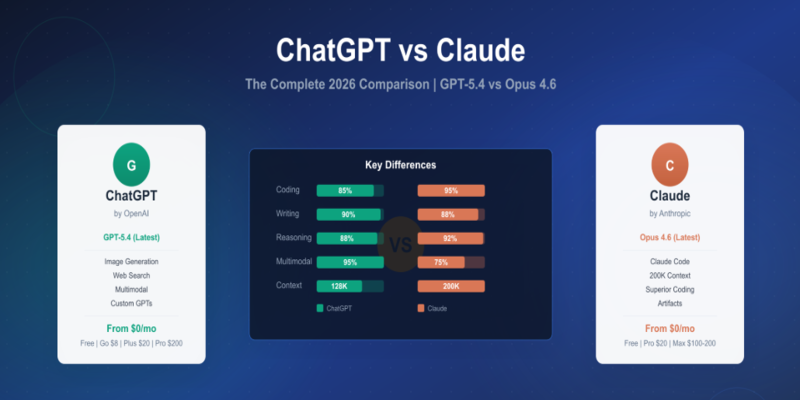
Allocating your monthly budget for automated applications requires balancing recurring subscription fees against the specific usage restrictions enforced by each platform. This financial breakdown details the standard entry plans and core feature boundaries for the premier options in the current landscape:
| Premium Workspace Option | Base Monthly Subscription Price | Primary Feature Limits |
| ChatGPT Plus Plan | $20 per month | High access to flagship reasoning models with liberal everyday prompt caps. |
| Claude Pro Plan | $20 per month | Restricts total message volumes during peak hours but includes dedicated project sandboxes. |
While the baseline price tags appear identical across the industry, the structural value you receive depends heavily on your daily production demands. For specialists who focus on real-time internet browsing, multi-language voice dictation, and built-in image creation, the first suite remains a highly cost-effective choice. However, for professionals who prioritize deep mathematical reasoning, long-form document editing, and flawless instruction following, investing your monthly budget in the second framework provides a superior operational return.
User Adoption Trends Defining the ChatGPT vs Claude 2026 Split
The global adoption data shows a clear divergence in how different professional sectors choose their primary LLM. The choice in the ChatGPT vs Claude 2026 landscape is heavily dictated by individual technical needs and risk tolerance.
- Dynamic Product Teams: Marketing directors, agile project managers, and content creators heavily favor OpenAI due to its real-time multi-modal speed and fluid external tool integration.
- Technical Developers: Software engineers and system architects switch to OpenAI when they need rapid, high-volume boilerplate generation and instant API prototyping.
- Data and Legal Specialists: Financial analysts, corporate lawyers, and researchers show a strong preference for Anthropic’s engine due to its flawless long-context retention and superior structural reasoning.
- Academic Researchers: Educators and scientists choose Anthropic when parsing dense, multi-page scientific papers because it systematically eliminates logical hallucinations.
READ MORE : 11 Feature-by-Feature AI Tool Comparisons for Copywriting and Design Software
This structural split proves that users no longer pick a tool based on brand loyalty alone. As professionals optimize their daily operational workflows, understanding the nuances of ChatGPT vs Claude 2026 helps them deploy the right model for the right task. Ultimately, matching your specific cognitive load to the correct system architecture is what guarantees a modern competitive advantage.
Practical Expert Tips to Maximize ChatGPT vs Claude 2026 Workflows
To achieve the absolute highest operational efficiency, enterprises must abandon the single-model approach. Maximizing your output requires a hybrid strategy that utilizes the unique structural strengths of both platforms in the ChatGPT vs Claude 2026 era.
- Pipeline Orchestration: Use OpenAI’s fast agentic loops to scrape real-time web data and execute initial broad market research across external applications.
- Deep Structural Auditing: Feed that raw gathered research directly into Anthropic’s deep context engine to audit the data for logical inconsistencies or regulatory compliance.
- Dual-Model Code Refactoring: Let OpenAI quickly sketch out your initial API frameworks, then pass the complete codebase to Anthropic for final security patching and logic verification.
- Multi-Modal Asset Creation: Deploy OpenAI for processing low-latency voice, video streams, or live customer support interactions where raw execution speed is paramount.
By setting up these automated cross-model pipelines, you completely eliminate individual tool bottlenecks. Balancing your production needs between the two giants ensures that your business stays highly agile and technically resilient. Navigating the ChatGPT vs Claude 2026 landscape with this advanced engineering mindset is the ultimate secret to scaling your digital output.
Establishing Consistent Prompt Maintenance Habits for Long-Term Enterprise Stability
Reviewing targeted ChatGPT vs Claude 2026 performance metrics allows teams to optimize their custom instruction guidelines for the specific engine they select. Documenting subtle model responses protects your internal pipeline from sudden quality drops, transforming basic chatbots into highly scalable workplace tools. Ultimately, maintaining updated template logs guarantees that your chosen software stays perfectly aligned with your long-term commercial goals.
SOURCE: https://bestaitools.reviews
CATEGORY: AI Comparison